

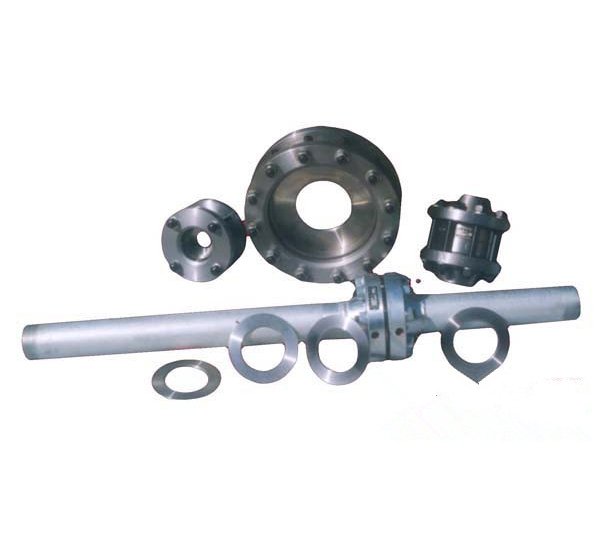
1. Airfoil-Type Airflow Measurement Device
The airfoil airflow measurement device is currently the most widely used flow measurement device in the domestic power industry for both primary and secondary airflow measurements. Compared with other airflow devices, it has the following advantages:
a. The unique airfoil profile generates a large differential pressure, ensuring stable measurement.
b. It uses a dual-airfoil or multi-airfoil structure, which makes the device short in length and requires shorter upstream and downstream straight pipe sections.
c. The pressure loss is small, not exceeding 14% of the differential pressure value.
d. The flow stream is uniform and stable, with a certain rectifying effect on the fluid.
e. Easy installation and maintenance.
f. High accuracy, with an error not exceeding 2% within the range of 30–100% of rated flow.
-
Model: LGJT-A (Flange Connection), LGJT-B (Welded)
-
Pressure tapping method: Special tapping
-
Applicable pressure: ≤1.6 MPa
-
Applicable pipe diameter: ≥300 mm
-
Component standard: Industry standard
-
Structural form: (as shown in the right figure)
2. Dual Venturi Tube and Insertion-Type Low-Pressure Loss Flowmeter
This device is suitable for flow measurement in various square or round pipelines. It has extremely low pressure loss, is cost-effective, and requires shorter straight pipe sections, making it especially suitable for large diameter and high-flow measurements.
-
Model: LGST, LGFT
-
Pressure tapping method: Special tapping
-
Applicable pressure: ≤6.4 MPa
-
Applicable pipe diameter: 360–3000 mm
-
Component standard: Industry standard
-
Structural form: (as shown in the left figure)
3. Averaging Flowmeter (Annubar Flowmeter)
This device is suitable for flow measurement in various square or round pipelines. It has extremely low pressure loss, is cost-effective, and requires shorter straight pipe sections, making it suitable for large-diameter and high-flow measurements. It is widely used for airflow measurement.
-
Model: LGZT
-
Pressure tapping method: Special tapping
-
Applicable pressure: 0.01–6.4 MPa
-
Applicable pipe diameter: 25–3000 mm
-
Component standard: Industry standard
-
Structural form: (Round or diamond shape, as shown in the left figure)
4. 1/4 Circle Orifice Plate, Conical-Entrance Orifice Plate, and Dual Orifice Plate
For cases with very low pipeline Reynolds numbers or high medium viscosity, it is difficult to achieve accurate measurement using standard orifice plates or nozzles. These devices are specifically designed for such applications.
-
Model: LGEH, LGEF, LGRH, LGYH
-
Pressure tapping method: Ring chamber tapping, drilled tapping, flange tapping (D≥40)
-
Applicable pressure: ≤1.6 MPa
-
Applicable pipe diameter: 25–400 mm
-
Component standard: Industry standard
-
Structural form: (as shown in the left figure)
5. Segmental Orifice Plate and Eccentric Orifice Plate
These orifice plates are suitable for flow measurement of dirty media. They allow media containing sediment or suspended solids to pass through more easily, preventing accumulation at the front end of the orifice plate, which could affect measurement accuracy.
-
Model: LGQZ, LGQF, LGQJ
-
Pressure tapping method: Drilled tapping, flange tapping, radial tapping
-
Applicable pressure: ≤16.0 MPa
-
Applicable pipe diameter: 50–2000 mm
-
Component standard: Industry standard
-
Structural form: (as shown in the left figure)
6. Integral Small Orifice Plate and Built-In Small Orifice Plate
Small orifice plates are suitable for flow measurement in pipelines with an inner diameter less than 50 mm.
-
Model: LGMZ, LGNF
-
Pressure tapping method: Corner tapping, flange tapping
-
Applicable pressure: ≤16.0 MPa
-
Applicable pipe diameter: 15–50 mm
-
Component standard: Industry standard
-
Structural form: (as shown in the left figure)
7. High-Pressure Lens Orifice Plate
High-pressure lens orifice plates are suitable for flow measurement in conditions where the pressure exceeds 20 MPa. They are commonly used in high-pressure applications in the chemical and refining industries.
-
Model: LGGH
-
Pressure tapping method: Corner tapping
-
Applicable pressure: ≥20 MPa
-
Applicable pipe diameter: 15–150 mm
-
Component standard: Industry standard

Reviews
There are no reviews yet.