


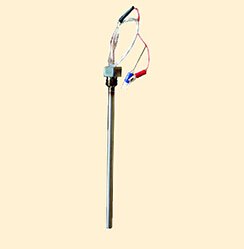
Working Principle
- Micro Thermocouple:
A micro thermocouple operates based on the Seebeck effect, where two dissimilar metals joined at one end generate a voltage that correlates with the temperature at the junction. The miniature structure allows it to detect localized heat changes with high responsiveness. - Micro RTD (Resistance Temperature Detector):
A micro RTD measures temperature by monitoring the resistance change of a thin platinum wire or film. As temperature increases, the resistance increases in a predictable manner. Micro RTDs provide high accuracy and repeatability, especially at lower temperature ranges.
Materials and Structure
- Sensing Element:
- Thermocouple: Fine wires of K, J, T, or E type alloys
- RTD: Thin-film or wire-wound platinum (Pt100 / Pt1000) elements
- Sheath & Insulation:
- Outer sheath: Stainless steel, Inconel, or Teflon-coated for chemical protection
- Insulation: Mineral Insulated (MI) cable, ceramic, or PTFE depending on application
- Lead Wires:
- Ultra-fine enameled copper, fiberglass, or Teflon insulated conductors for compact routing
- Tip Size:
- Probe diameters as small as 0.25mm to 1.5mm, making it ideal for embedded or surface measurements
Applications
- Semiconductor equipment
- Medical devices and instruments
- Miniature motors or bearings
- Aerospace systems
- Precision mold temperature control
- Battery pack temperature monitoring
- Microscale scientific experiments
- Embedded electronics or circuit boards
Advantages
- Ultra-compact, suitable for tight or confined spaces
- Fast thermal response for real-time monitoring
- Compatible with data loggers and PLCs
- Customizable probe length, connector, and wire type
- Available in Class A/B accuracy for RTDs